A11yAuditor.io
Independent tool • Research & development
Published:
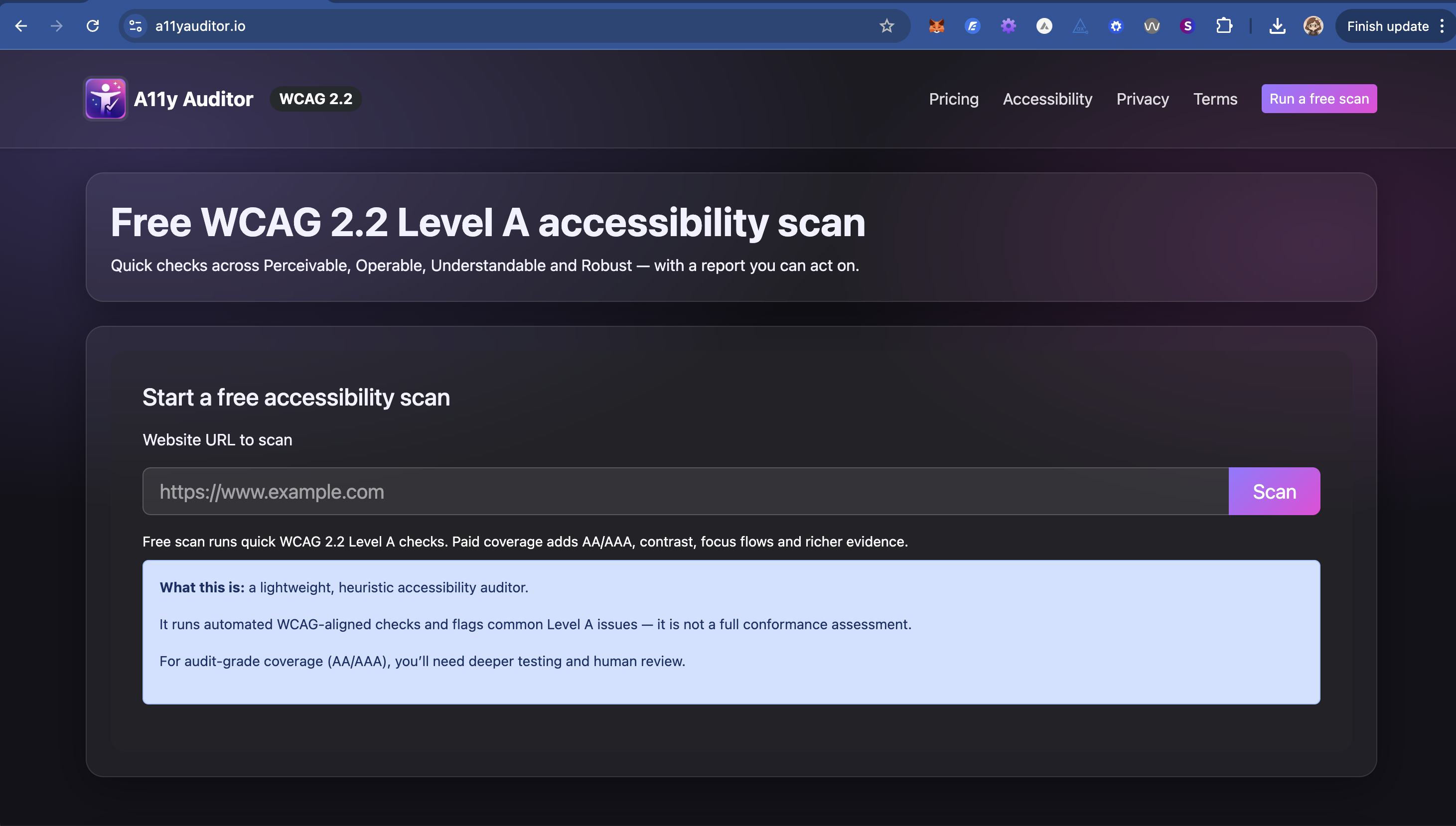
A free WCAG 2.2 Level A scan designed for fast triage: enter a URL, get a prioritised report, and act on the highest-impact issues first. Use it as a lightweight gate before deeper manual audit and remediation planning.
This case study reflects our approach to AI governance and quality engineering, detailed in our Services.
Note: This is an independent tool. Not client work.
Why we developed it
Most organisations don’t fail accessibility because they’re malicious — they fail because delivery moves fast, ownership is fragmented, and “we’ll fix it later” becomes permanent. Teams need a fast, defensible signal that catches obvious issues early, before they ship exclusion into production.
A11yAuditor.io exists to make that early signal cheap and immediate. It’s deliberately scoped to Level A so teams can baseline quickly, stop the bleeding, and then do the real work: deeper audit, remediation, regression proof, and governance controls.
What this tool is trying to achieve
- Fast accessibility triage for delivery teams
- Prioritised fixes that reduce user harm
- Clear, explainable findings mapped to WCAG criteria
How to use the scan
- Enter the page URL into the scanner.
- Run the scan and wait for the report to generate.
- Start with the top-priority items: issues that block navigation, meaning, or interaction.
- Fix, re-scan, and treat it as a repeatable pre-release check.
Tip: Automated scanning is a fast gate — not conformance proof. Use it to catch obvious failures early, then back it with manual testing.
Design intent
What the tool does
- Runs a lightweight, URL-based scan aligned to WCAG 2.2 Level A
- Surfaces prioritised issues with practical remediation guidance
- Helps teams triage risk early and repeatedly
- Supports governance-led release gating (evidence beats reassurance)
What it deliberately does not do
- Claim full compliance or legal/standards conformance
- Replace manual testing with assistive tech
- Guarantee coverage of every failure mode (automation never does)
- Pretend accessibility is solved by a report
Privacy & data handling
The scan is initiated from a URL you provide. The tool is designed to minimise data exposure by not requiring accounts, logins, or user-provided personal information to run a report.
- No account required
- No need to upload documents or user data
- Designed for quick triage without unnecessary collection
What this shows in practice
This project demonstrates how Xyphos treats accessibility as a delivery control — not a UX clean-up. In regulated contexts, you don’t get to hand-wave. You need repeatable checks, clear evidence, and release discipline.
- Risk-based triage (fix what blocks users first)
- Governance-led delivery (evidence as the default)
- Practical tooling that supports real delivery constraints
Research & references
Standards and guidance
Want governance-led delivery that holds up under scrutiny?
If you're operating in a regulated or high-risk environment and need practical controls, assurance, and delivery discipline, let's talk.